"Aha" says the Moral Philosopher triumphantly, polishing his monocle ferociously with a large handkerchief. "You have contradicted yourself! If you say yes to the first case you should say yes to the second, for you have already revealed your acceptance of the principle that one person should be sacrificed for the many."
Many people - even many philosophers - think that morality and ethics are the same thing. But they are not. Morality is primarily about making the correct choices, while ethics is about proper reasoning.
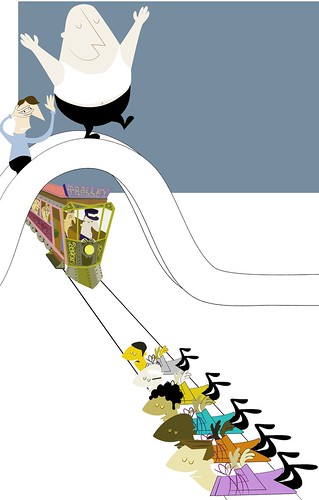
Take the so called 'trolley problem', a thought experiment about runaway trains invented by the late Philippa Foot and very popular with moral philosophers of a certain whimsical bent. A train is hurtling down a track and you see that it is going to hit a group of 5 people and will certainly kill them all. However you happen to be standing next to a switch that can divert the train down another track where only a single person would be killed. Most people say they would pull the switch and kill 1 rather than 5. (Visit philosophyexperiments.com to read the full outline, try out your own intuitions against various iterations of the situation, and find out what other people decided).
![]() |
| Should you kill the fat man? |
Most people who say yes to diverting the train say no to pushing the fat man. But if you do, many moral philosophers would say you have made a mistake, not because you are wrong about whether or not to kill people to save others, but because you are being inconsistent about your killing decisions.
This reveals much about the character of contemporary moral philosophy and its relationship with individual rationality and the associated formal virtues of consistency, transitivity, and menu independence. "Morality" derives originally from the Latin, mores (norms), and is concerned with the correct derivation and application of moral rules. It is legalistic in the sense that it thinks that laws should determine everything. Morality therefore has two concerns: i) the content - 'what are the moral laws?' (whether the 10 commandments or Kant's categorical imperative); and ii) their application - 'which moral law does this case fall under?' It is supposed that the hard part of morality is coming up with good rules, while their application will be more or less formulaic. Hence, the moral philosopher in the trolley case does not criticise your choice of principle (the formula: sacrifice one for five) but does feel more than qualified to criticise your inconsistent application of it.
Is this a realistic model of morality? Does it characterise how you think about moral problems, or think you should? Fortunately there is an alternative. Ethics.
Ethics comes from the Greek tradition that emphasises ethos (character), though it remained important right up until the enlightenment and is still popular today in our ordinary talk and thinking. It asks 'What kind of person is good?' This is personalised as 'What kind of person should I be?' It is particularised as 'How should a good person behave in this case?' Ethics emphasises the responsibility and capability of the individual (hence character) to come to her own conclusions through reasoning, to be the judge of which principles are relevant in a particular case and how they should be considered in combination. The ethicist does not think that moral laws interpret themselves and sees that view as deeply naive about the importance of moral reasoning (in the way that believing that all supreme court justices do is read the constitution and do what it says is naive).
The important thing about judges is that they are themselves responsible for making their decisions - not some independent formula - but their reasoning itself has a universal aspect. No judge, whether of the quality of an artwork, a gymnastics competition, or a murder trial, is allowed to simply announce their conclusion and leave it at that, as if it were only a personal opinion. Unlike opinions, which one may have about one's favourite icecream flavour or the morality of capital punishment in general, judgements must be justified by the characteristics of the case in hand and expressed in a way that seeks inter-subjective agreement from others with an interest in the matter. Judges must be able to show by explaining their reasoning that anyone else in their position should come to their conclusion, e.g. that this and this are the salient features of this case and should be understood and weighted in this way. They must be prepared to persuade others, and to modify their reasoning and conclusions in the light of relevant contrary evidence and arguments.
So, turning back to the trolley problem, The problem I see with the straightforward moral philosophy approach is that it fails to distinguish between reasoning and choices, and thus interprets any inconsistency of choice as evidence of inconsistency of reasoning. But from the ethical perspective people are seen as reasoning about which principles are relevant and how much they should count in these two different cases in order to come to judgements about what one should do. There is no point in trying to identify the formula the participant is using to decide what to do because there isn't one, and thus the moral philosopher's charge of contradiction - the inconsistent application of a formula - is misguided (a case of petitio principii - arguing for a conclusion already assumed in the premise).
All this is not to say that these thought experiments aren't interesting and useful, but we should be more concerned with evaluating - and challenging - the reasoning behind the participant's conclusion, where the real ethical action is, rather than studying matrices of choices to detect patterns and 'mistakes'.
![]() |
| 3 Quarks Daily Philosophy Prize 2011 |


Thanks for explaining both the difference between morality and ethics, and why the trolley problem is so prominent, neither of which I'd been able to grasp at all before. Still, it occurs to me that we pick up moral codes from those around us, and could hardly think ethically if we hadn't, and that then we can help others by codifying the results of our ethical thinking, adding that the moral codes are fallible and have exceptions. So even with the moral/ethical distinction, problems like the trolley problem seem important, as you say.
ReplyDeleteThey seem able to introduce young adults to ethics. But also, I wonder if the usual answers aren't inconsistent, that we shouldn't pull the lever if we aren't prepared to push. What, after all, is the difference? And are most people not just applying moral codes badly, when they say it's wrong to push the fat man to his death (but right for him to jump), but alright to kill the man by pulling a lever? I think people are thinking of analogous situations in which clearer moral codes apply. E.g. it would be OK for the driver to divert the train away from the five, e.g. because it's more likely that one could escape in time than that five could. And pulling a lever is like driving a train. And if I'm right about that, then the inconsistency is revealing a flaw in most people's ethical reasoning, so it's not moral vs ethical, but an interplay.
Thanks, enigMan. I am not against having principles - morals - but I am against casuistic approaches based on some determinate theoretical rule like consistency. The 'ethical perspective' (as I have called it to distinguish it from this) is based on reasoning about our principles in a way that acknowledges the foundational role of indeterminacy: that ethics is not about getting the 'right' answer, but your best effort at a good one.
ReplyDeleteWhere do our principles come from? From our previous experiences of exercising judgement, including that based on 'distance learning' about other cases from other people, as you say, or the news. Often we simply routinely apply our previously generated principles to new situations that don't seem to require very deep reflection. But sometimes we find those conclusions inapt - sometimes we have to be shown this - and we must undertake a fuller reflective deliberation in which our principles have the character of reasons in the production of new judgements, rather than merely alternative conclusions to choose between.
I only chose a common and very superficial interpretation of the Trolley Problem that I found particularly prominent in the experimental literature as a nice example to make my argument against casuistry. Much of the TP literature is far richer and more sophisticated than this and does focus far more on how people may be reasoning, or as you suggest, failing to reason properly.
I see; I'm in broad agreement with you then. (I've noticed that in logic consistency is prized in some wrong kind of way, and a connexion with indeterminacy being seen as a problem rather than a basic fact.)
ReplyDeleteHowever, I don't think the moral philosopher's charge of contradiction in the trolley case is misguided. It is the two judgements that are being inconsistent, irrespective of how they were come by, insofar as the situations are analogous. And to some extent they are. The problem is therefore to find some apposite difference. (Similarly in logic, the noticing of a contradiction usually triggers a clarification procedure.)
Furthermore, while we as philosophers think like ethicists, surely it's good that most people (including ourselves) are expected to work within a given moral framework. That means that we all benefit, not only from a coherent framework that we can all know, but also from intelligent revisions made by experts at the top. Most people should not push a fat man off a bridge whatever they think will happen (and especially not in order to derail a train), nor should they interfere with railway switches (whatever they think is happening).
But if you know how the switches work, then you may well be competent to switch the train to where one rather than five are. You have to judge that interfering is the right thing to do. But the description of the trolley problem gives you the relevant information. The problem with the trolley problem, as I see it, is that its descriptions make the two cases very similar. And yet in general, pushing a fat man to his death in order to derail a train with his body is not going to be a reasonable option. The information you are given shows that it is just as reasonable. It's just like pulling a lever. But the general case is very different. And in no possible world would you find yourself in such a case with such information as you are given (e.g. that no one on the train will die as it derails).
We have to get behind the inconsistency of judgements in order for the inconsistency charge to bite. We have to analyse the reasoning that is going on and show how it is problematic in its weighting and combining of reasons. If a judge sends one murderer to jail for 10 years, and another to the death chamber, that is not evidence of problematic inconsistency. If it turns out that the cases were in fact very similar, but one judgement seemed influenced by the race of the murderer, then we can start to criticise.
ReplyDelete"While we as philosophers think like ethicists, surely it's good that most people (including ourselves) are expected to work within a given moral framework."
Do you have some elitist view in mind? I reject that entirely. People are already ethical beings. Philosophers are simply in the business of creating theoretical - moral - systems to grasp that fact. I do not accept that philosophers know any better what the right answers to moral questions are (all the ethicists I know are quite profoundly ordinary in their everyday moral capacities and intuitions). I would hope that they could help us think moral problems through in a clearer and more systematic way. But the burden of proof is always on the theoretician to demonstrate the relevance of what he is saying and also to acknowledge the possible distorting effects of his theory on real, ethical life.
It's a bit like the case of neoclassical economics which also takes a formulaic approach to human behaviour. We all take part in the economy, but economists have created a theoretical system based on "economic agents" (homo economicus) characterised by the requirements of rational choice theory: whatever your preferences are, they must be characterised by transitivity and completeness, and your only goal is their maximisation. Of course, actual people do not behave in this way. Nor should they.
No, I didn't have an elitist view in mind; I think the confusion arose because by "philosopher" I didn't mean an academic theoretician, but something more like an amateur scientist. (What is and what should be philosophy?) We are all born into a culture, and then we can choose to think about it (the culture gives us some ways of doing so, and we can choose to augment or ignore them). I think that basically, arguments can be used to win stuff or to pursue the truth, and in the latter case we are being philosophical. Other than that, I think you're right.
ReplyDeleteSome people pursue academic careers only to earn stuff, I suppose; and while our personal thinking spirals (unpredictably and hermeneutically), academia rewards early success (and our culture popularity). So I think that we do have a problem with modern academic theories (as we used to have a problem with entrenched tradition). I sometimes wonder if that problem wouldn't be lessened by our being more elitist (in some meritocratic way), but that's not what I was saying.
Anyway, I wonder if you think that the Trolley Problem shows Kant to be right? The two scenarios can be made more and more similar, until the only difference is that in one the death is inevitable but in some way incidental, while in the other it is more instrumental. The former seems alright, the latter wrong; but those are intuitions, not reasons. Without such a difference, the killing decisions would seem to be inconsistent.
It occurs to me now that there's some basic division between what we would do and what we would want someone in authority to do. In a democracy, we need to think about the latter as though it was our choice, even when we personally can only act in the former way. So for example in the Trolley problem, I would be Kantian in both scenarios when it comes to my personal actions (and so have to explain why I would not pull the lever) but if I had the authority I would aim for the lowest number of deaths in both scenarios (although I still think that pushing the fat man to derail a train is too unrealistic to be anything but a rhetorical device designed to reveal some sort of hidden distinction). So I now wonder if that distinction is related to the distinction between ethics and morality?
ReplyDeleteSo perhaps the politics includes the authority to make difficult moral decisions on our behalf. Is that so we don't have to, because deciding between different terrible options is hard going? But then how do politicians decide whether to spend limited budgets on reducing road deaths or curing cancer? I think they also outsource their decision-making to bureaucratic procedures as much as they can.
ReplyDeleteI was called for an interview today and was asked what i think the difference between morality and ethic is, and i was shocked. I stumbled a little and eventually concluded that there is no difference. The interviewer looked (scornfully) at me thereafter.
ReplyDeleteThis question continues to perturb me and make me very uncomfortable long after the interview; i tried to reason out with myself what exactly is the difference and came to a slightly different conclusion from yours.
Morality is a narrower concept that involves deeply personal beliefs and reasoning.
Ethics, on the other hand, represents a 'code of conduct' or a 'rule' that the society or association impose. This 'association' that i have mentioned refers to a group or community that i have joined.
For instance:
I join the medical community to be a doctor so i have to obey or pledge myself to the medical ethics.
I join the business community to be an entrepreneur so i should obey the business ethics like: honesty is the best policy.
You get the idea..
So for me ethics is about a collective rule imposed by a community. Arguably, as humans we can say that we belong to the 'human' community and should obey the 'human' ethics...
You say:
(Ethics) asks 'What kind of person is good?' This is personalised as 'What kind of person should I be?' It is particularised as 'How should a good person behave in this case?' Ethics emphasises the responsibility and capability of the individual (hence character) to come to her own conclusions through reasoning, to be the judge of which principles are relevant in a particular case and how they should be considered in combination.
Your passage appears to boldly claim that ethics involves reasoning and arguing whereas morality involves simplistic assertion of ones personal beliefs that hasn't gone through the thought process.
I would disagree. Instead, if anything, i would claim that ethics is a 'worse off' concept as it imposes majority rule; ethics constricts autonomy and the free will of individuals.
Also morality is not mere assertion like what u said. It is about reasoning and debating with ourselves. In Michael Sandel, Harvard professor for Philosophy, words:
"We sometimes think of moral reasoning as a way of persuading other people. But it is also a way of sorting out our own moral conviction, of figuring out what we believe and why"
Therefore morality is about reasoning with ourselves. Should we agree to euthanasia? Why should we agree with euthanasia? Or why should we not? Is it because euthanasia helps to end suffering and maximise personal utility (utilitarian moral reasoning)? Or is it because there is something intrinsic/some dignity about the human life and so we should not use our own lives as means to some end -- to stop pain/ mitigate pain (Kantian moral reasoning)?
Such morality is certainly not mere simplistic assertion of personal beliefs that has no element of reasoning, is it?
To end off, i would like to pose an over-used scenario:
Suppose that in a hospital lie 6 dying people. 5 of them are dying as they each lack a certain organ (each of them lacks a different organ). The 6th person is dying due to a car accident.
Assumption: You know for sure that the 5 people will die before the 1 person dies, and so u cannot 'wait' for the 1 person to die first. You also know for sure that extracting the organs from the 5 and implanting them into the 1 will definitely save the 5 and kill the 1.
Your medical ethics says that it is wrong to kill or deny a person of his life.
ReplyDeleteYour personal belief (morality) is slanted towards utilitarianism and you believe (personally) in maximising utility.
Your decision: You eventually killed the 1 to save the 5.
Jugement: Are you (or 'I am" if the direct questioning is uncomfortable) wrong? Or are you right?
Ethically speaking, according to the common code of conduct or collective rule by the medical community, I am wrong because i have denied a person of his life.
But morally, according to my own moral reasoning, i am right because i stayed true to my own beliefs and i can reason, and NOT simply assert, my decision.
So am i wrong or am i right in the killing?
I personally believe that there is no answer to the question in part because this is a philosophy-question and there is no answer to such questions, and also in part because in reality most doctors will not kill-- not because the social code (ethics) reigns supreme, but because in being a utilitarian, the doctor would also take into account his OWN negative utility: the suspension of license, possibility of incarceration, personal future 'guilt' etc etc. And if i may, i would say that the doctor would weigh his OWN negative utility quite or even much more strongly.
But i would say that the doctor is entitled to being punished because he has flouted the rule/code of conduct (ethics).
I appreciate, O Bearded One, the way in which you have distinguished morality and ethics. I may even refer to and employ your version of the distinction, turning it to my own purposes.
ReplyDeleteBut I have also been in the position described by Undescore above, asked to distinguish the two. My response here is partly a note in simpathy and solidarity with Underscore.
I think the terms are ambiguous, and there are several different and equally acceptable ways to cut the distinction. When people speak of "professional ethics," for example, they often intend to refer to positional responsibilities that are supposed to accrue to particular professional roles. But this isn't the way our Bearded Host has employed the distinction above.
Underscore, in the predicament you describe, I gave the same response you gave: I said that I typically use 'ethics' and 'morality' interchangeably and that I planned to do so in the remarks I was about to deliver.
This inspired the same scornful look you report having received yourself, as well as a vehement retort excoriating me for my ignorance of such a simple and common conceptual distinction.
So I followed up noting that there are contexts and philosophers who use these terms differently. Where terms are ambiguous in this way it's useless to assume that there is One Right Way to cut the distinction. The way forward is to stipulate in advance which convention one will adopt, not to suppose that there is only one way to slice the conceptual pie. Our Bearded Friend has done precisely this in his remarks above, so perhaps he will regard this as a friendly and supportive suggestion.
But my interlocutor was a Fundamentalist. He knew the One True Way to slice, and was still prepared to heap Scorn upon the unwashed (me). Underscore, perhaps we have encountered the same person?
Yours in solidarity,
Seneca
Seneca,
DeleteI quite agree. I think my distinction is a good one, in that to does useful philosophical work, but I freely admit that the labels I have used have been used differently in the past and my claim to them may be contested.
However, I didn't begin with looking at the words "morality" and "ethics" and trying to figure out what they really meant. Rather I started by finding a need for a distinction in moral philosophy and then trying to articulate it. The labels are the least important part of that process.
People find pulling a switch from a distance as the lesser of two evils...it's more impersonal than actually being the one who must PUSH an innocent man to his death. Albeit to save and kill the same numbers no matter which method is chosen.
ReplyDeleteThe fact that we must touch the fat man, perhaps see his terror at our act is unbearable. Where in the first case, pulling a switch...we can imagine it's the train that is killing the people. We just minimized the damage.
Very interesting article! Thank-you. A.
aphroditesmusings.wordpress.com
I think that your distinction relies on the wrong root. Websters New World College 4th edition says that the Greek ethos means both character and custom. Morality comes from mos, moris, a word that refers to manners and customs. This includes character because manners and customs mark (the root of character is charassein, to engrave) the good person. An emphasis on character thus does not divide morality and ethics. Cicero, for instance, used moris to translate ethikos without any confusion on the importance of character. However, the meaningful difference is that ethike combines ethos with techne. techne is skill, method or craft, which all have to do with process. This would seem to be the difference between ethics and morality that you focus on.
ReplyDeleteThanks!
Delete