Thursday, 17 September 2015

Privatise the Monarchy!

Source
Are you a subject or a citizen? You're not alone if you're not sure. Many supposedly liberal democracies - from Britain to the Netherlands to Canada - still live under a constitutional bricolage of medieval and republican institutions.

We deserve better. In our private lives - in the private space for decision-making that citizens enjoy - those who like the monarchy can continue to express that admiration, just as those who wish to worship within a particular religious denomination can do so. But there is no justification for continuing the undignified farce of constitutional monarchy.

Saturday, 25 July 2015

Why Not Polygamy Too?

The argument that made gay marriage law in America was about marriage equality: not special rights for gay people but the right to the same treatment. There may be something to regret in the smallness of this ambition (previously), but the argument is sound. 

Denying people the right to marry requires a public justification -one that would be in principle convincing to all concerned - and this demands more than the expression of the private moral beliefs of a politically dominant group like fundamentalist Christians. What this comes down to is the moral and political significance of the challenge Why not? for public reasoning in a liberal society, for identifying and overturning unjust laws and policies. 

In the wake of the US Supreme Court's decision it is therefore rather disconcerting to find various gay marriage advocates, most notably, Jonathan Rauch, arguing so badly - basically sneering - against polygamy. One has the impression of a drawbridge being raised up. As far as I can tell, polygamy presents as good a case as gay marriage for legal recognition and regulation by the state, as Justice Roberts' Supreme Court dissent pointed out.

Saturday, 4 July 2015

Advertisers Should Pay You

Source
Advertising is a natural resource extraction industry, like a fishery. Its business is the harvest and sale of human attention. We are the fish and we are not consulted.

Two problems result from this. The solution to both requires legal recognition of the property rights of human beings over our attention.

First, advertising imposes costs on individuals without permission or compensation. It extracts our precious attention and emits toxic byproducts, such as the sale of our personal information to dodgy third parties.

Second, you may have noticed that the world's fisheries are not in great shape. They are a standard example for explaining the theoretical concept of a tragedy of the commons, where rational maximising behaviour by individual harvesters leads to the unsustainable overexploitation of a resource. Expensively trained human attention is the fuel of 21st century capitalism. We are allowing a single industry to slash and burn vast amounts of this productive resource in search of a quick buck.

Monday, 29 June 2015

Marriage Equality Is Not Enough

The campaign to legalise gay marriage in Western countries has been wildly successful. Political and popular opposition has crumbled in the face of the reasonable demand for a public justification for banning it. The feeble excuses for arguments trotted out by its opponents - including religious institutions, talking heads, politicians and lawyers in court - are increasingly perceived as mere rationalisations for bigotry. This is democracy as public reasoning at its best (and has been cited as such by political philosophers - e.g.).

As a liberal I find much to celebrate about this victory. Yet, at the risk of offending the righteousness of the left, I also see something to regret. The line of reasoning behind the marriage equality movement is disappointing in the smallness of its ambition. It holds up a mirror to the wider renunciation of radical idealism by what passes for the left these days.

Proponents of marriage equality have overwhelmingly argued that it is unfair to treat homosexual relationships differently from heterosexual ones because they are in every significant respect the same. As a rhetorical strategy to advance marriage rights and the acceptance of homosexuals in general this argument may be justified by its political success. But as public reasoning such a justification is disappointing. It does not really advance the idea of equality of deep freedom: it is a demand to have one's conformity accepted rather than to have one's difference respected.

Tuesday, 21 April 2015

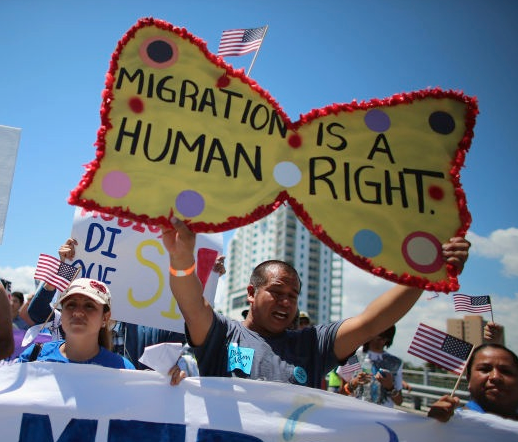
Will We Be Able To Justify The International Birthright Lottery To Our Grandchildren?

It is drowning season again in the Mediterranean. Over the coming months, thousands of people will die wretched little deaths in pursuit of a better life in Europe. Hundreds of thousands will risk all they have anyway, just as they do every year. And just as we do every year, we will demand that more be done to prevent them dying on our doorstep in such a visible and embarrassing way

The drowning season is an embarrassment because it threatens our moral complacency. We enjoy believing that we care about human rights and we have signed all sorts of treaties and agreements promising care to refugees fleeing lives of squalor, fear, and oppression. But we also have no serious intention of fulfilling our promises to help foreigners. That's why we make them climb into those leaky fishing boats to reach us. 

Embarrassment is discomforting. How will we deal with it? By focusing on the deaths and who is to blame - the dastardly people smugglers, the under-resourced Italian navy, sclerotic EU institutions, Libya's warring factions, the foolish refugees themselves? Or by recognising and answering the moral challenge before us. 

Tuesday, 17 March 2015

The Asshole Theory of International Relations: Why some countries are so ghastly and what to do about them

Some countries are assholes. They trample on international norms about human rights, weapons trafficking, maritime borders; sabotage negotiations to end civil wars; bully their weaker neighbours; and so on. They make and break promises repeatedly and shamelessly, and complain with violent indignation if they are challenged for it, all the while declaring their commitment to the highest ideals of international peace and cooperation.

You know the kind of country I'm talking about. The kind that believes in its own moral exceptionalism: Not only does it not feel bound by the ordinary rules; it even demands that other countries acknowledge its moral right to set its interests above their own or the international peace. Russia is an obvious current example. I'm sure you can think of others.

Saturday, 28 February 2015

Children are special, but not particularly important

A strange idea has taken over the social conscience so entirely that it is a taboo even to say what it is. Children have come to be seen as more valuable than adults not despite but because they lack the psychological maturity that makes persons objectively valuable.

Consider the appearance of "baby on board" placards from the mid-1980s onwards.


Nobody would have placed such a sign on a car if it were not already understood by society that the life of a human achieves its peak value at birth and declines thereafter. A toddler is almost as precious as a baby, but a teenager less so, and by the time that baby turns fifty, it seems that nobody cares much anymore if someone crashes into her car. You don't see a lot of vehicles with placards that read, "Middle-aged accountant on board." (Danielle and Astro Teller)
Something has gone very wrong in the way we think of the ageing process! Fortunately philosophy can help.