Showing posts with label ethics and economics. Show all posts

Thursday, 17 October 2024

Hard Drugs Have Become Too Dangerous Not To Legalise

Republished on my substack

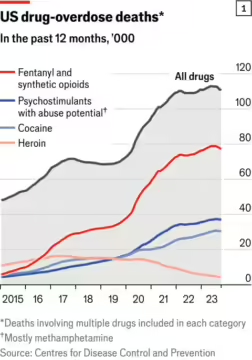
Drug overdose deaths have more than doubled in America in the past 10 years, mainly due to the appearance of Fentanyl and other synthetic opioids. These drugs combine incredible ease of manufacture with potency in tiny amounts and dangerousness (the tiniest miscalculation in dosage makes them deadly).

This continues a general and no longer surprising trend. The global war on drugs has produced a strong selection effect for drugs which are easy to manufacture and smuggle but at the cost of being much more dangerous for consumers. There is no reason to expect this trend to alter. Moreover, Fentanyl leaks – it appears as an additive in all sorts of other illegally bought drugs, like Xanax, surprising and killing consumers who had no idea what they were getting.

The best thing we can do about this – and hence the right thing to do – is to legalise all hard drugs so that consumers have a real choice about the dangers they subject themselves to.

Sunday, 23 October 2022

How Many Children's Lives Is That Worth?

According to the meta-charity GiveWell, the most effective charities can save a child’s life for between 3 and 5,000 US dollars. One way of understanding this figure is that whenever you consider spending that amount of money, one of the things you would be choosing not to spend it on is saving a child’s life.

Take the median of the GiveWell figures: $4,000. I propose that prices for all goods and services should be listed in the universal alternative currency of percentage of a Child’s Life Not Saved (%CLNS), as well as their regular prices in Euros, dollars, or whatever. For example, a Starbucks Frappucino might be priced at 5$ /0.13%CLNS. A Caribbean holiday cruise might be priced at $8,000/ 200%CLNS (perhaps written as emojis🪦🪦)


Sunday, 28 August 2022

On The Incoherence Of The Claim That 'Taxation Is Theft'

The idea that 'taxation is theft' is one of those thrilling, paradigm shifting recognitions that are continually being rediscovered and shared. It is a classic case of pseudo-intellectuality, in which the excitement around an idea determines its popularity, rather than its quality (previously).

First, unlike theft, taxation is legal - and this turns out to be a more significant difference than it first seems since we rely on laws to determine who owns what. Second, taxation is a device for solving collective action problems and thus allowing us (by coercing us) to meet our moral obligations to ourselves and each other - including our obligations to respect each others' property rights. One can't coherently be in favour of enforcing property rights, e.g. by having a police force and judges to catch and punish thieves, without also being in favour of a sustainable system for funding that enforcement.


Monday, 14 June 2021

Vaccination Need Not Be Compulsory To Be Universal

Covid-19 vaccination take up has been disappointingly low in many countries, or parts of countries, such as in America. Given that vaccination offers significant private and public benefits, this is surprising. Is it permissible or even required for governments to compel or incentivise vaccination, and if so, how?

Friday, 26 March 2021

Why Are Moral Philosophers So Bad At Global Justice?

There is a dismaying intellectual sloppiness to how moral philosophers as an intellectual community approach issues of global justice. They are not only ignorant about basic, important, and easily checked empirical facts, but also complacent about their ignorance. For example, they disdain to acknowledge the expertise of those scientists (especially economists) whose conclusions or methods they find counterintuitive or disagreeable, and prefer to develop their own theories or seek out those self-professed experts who say things more in line with their preconceptions about how the world works. The result resembles the self-sustaining but fundamentally worthless epistemic communities organised around the rejection of vaccination or climate change. Philosophers are willing to write long articles and whole books explaining their views about how unfair the world is, and to read and respond to each others' complaints, but they have little to offer to the reality based community. 

This shit matters. Bad global justice theorising reinforces anti-intellectual and conspiratorial myths about how the world works that would keep whole countries and hundreds of millions of people mired in poverty. On the one hand - fortunately - few people in positions of influence take this drivel seriously. On the other hand this is still a missed opportunity to have engaged philosophers' supposedly superior reasoning skills and expertise on value questions about issues affecting billions of people. Moreover, it pollutes the political conversation by training our students and anyone else who will listen to be stupid about global justice and by giving intellectual cover to populist 'common sense' opposition to free trade and other sensible pro-poor policies.